
More Than a Halftime Show
Why Language, Culture, and Discomfort Mattered on Super Bowl Sunday

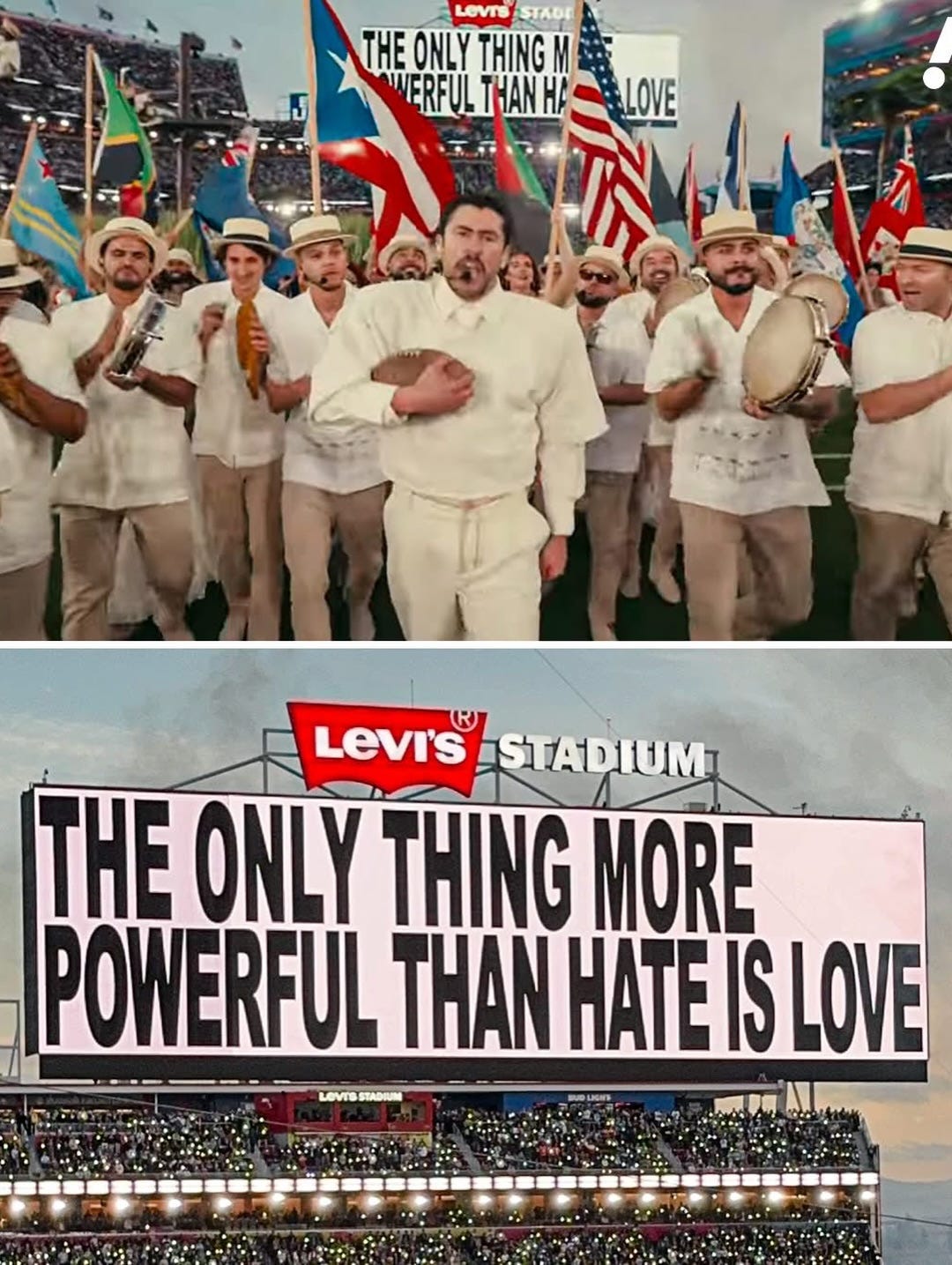
I don’t usually pay much attention to the Super Bowl. It isn’t a cultural moment I’m particularly drawn to, though I respect that it is for many others. But the response to this year’s halftime show caught my attention.
My immediate thought was not about the music or the spectacle, but about the backlash it would likely provoke. I sensed there would be anger—and that the anger itself was worth examining.
This morning, I decided to look more closely at what was being said and why it might feel so disruptive. I wanted to understand the meaning behind the language, the structure of the message, and what was being communicated without translation. This Substack article is the result of that inquiry, developed through research and analysis I worked through with ChatGPT today. I used it not as an authority, but as a translation and analysis tool to help me understand the message.
There was a moment during the Super Bowl halftime show when I noticed a subtle but powerful tension ripple through the audience.
Bad Bunny performed largely in Spanish.
There were no subtitles.
No explanations.
No softening for comfort.
For some viewers, this was probably just unfamiliar. For others, I suspect it was frustrating. And for a subset—particularly those already primed by fear, grievance, or nationalism—it may have been genuinely angering to be “in America” and not be centered linguistically.
That reaction matters.
Because the language barrier was not a mistake.
It was part of the message.
Rather than disengage or dismiss the performance, I got curious. I went to ChatGPT to understand what was being said—what I might be missing if I stayed on the surface. And what I found was not a party setlist, but a coherent psychological and cultural arc, especially in the final three songs.
Those last three songs carried a message I believe is important for all of us to hear right now.
The Hidden Work of Discomfort
When we don’t understand the language, something interesting happens. We are no longer centered. We are no longer catered to. We have to choose whether we will:
Turn away in irritation
Demand translation on our terms
Or lean in with humility and curiosity
That choice is not just linguistic. It’s psychological.
Discomfort often reveals where we expect dominance without realizing it.
And Bad Bunny did not rush to relieve that discomfort.
The Last Three Songs as a Psychological Sequence
The final three songs—El Apagón, Café con Ron, and DtMF—form a quiet but powerful progression when viewed through a trauma and sovereignty lens.
They are not random.
They are not merely cultural references.
They are an arc.
El Apagón — Naming the Injury
El Apagón speaks to collective trauma: power outages, land loss, neglect, corruption, and being told—implicitly or explicitly—to stay grateful anyway.
Trauma thrives when harm is normalized and voices are dismissed.
This song refuses that silence.
It names instability as injury.
It names exploitation as exploitation.
It names truth as a boundary.
El Apagón is often heard as a song about power outages. But the outages are only the surface symptom.
Beneath them is a deeper story: land sold off to private interests, infrastructure handed to corporations with no accountability, and local people left with the consequences. Electricity fails, housing prices surge, communities are displaced—and when people protest, they are told this is progress. Or worse, that they should be grateful.
This is not just a Puerto Rican story.
Puerto Rico functions, in many ways, as a testing ground—a place where privatization, deregulation, and disaster capitalism can be pushed further, faster, with fewer consequences for those in power. What happens there does not stay there. It becomes precedent.
Listening closely, El Apagón is not only naming what has already happened. It is issuing a warning.
The song describes a pattern we are increasingly seeing across the continental United States as well:
land consolidated into fewer hands,
housing treated as an investment vehicle rather than shelter,
public goods quietly privatized,
and entire communities priced out of continuity.
What Puerto Rico has experienced is not an exception. It is an early version.
From a trauma perspective, this kind of systemic exploitation creates chronic instability. People cannot plan. They cannot rest. They cannot trust that what sustains life—power, water, land, home—will still be there tomorrow. The nervous system remains on alert, while those benefiting from the system remain untouched by its failures.
From a sovereignty perspective, the song draws a clear boundary:
this land is not a commodity,
this suffering is not invisible,
and silence is not consent.
What makes El Apagón so uncomfortable—and so important—is that it refuses the illusion that exploitation is localized. It reminds us that if we normalize these dynamics anywhere, we make them possible everywhere.
In that sense, Puerto Rico is not “behind” the rest of the country.
It is ahead of us.
Café con Ron — Regulating Together
After trauma is named, the nervous system needs grounding. Not productivity. Not slogans. Connection.
Café con Ron is about shared moments: staying awake, softening the edges, sitting together, talking, remembering. Coffee to endure. Rum to ease. People to co-regulate.
This is how cultures survive pressure without hardening.
Sovereignty here is not rebellion.
It’s rootedness.
It says: We remain human together.
If El Apagón names the injury, Café con Ron shows what people do to survive it without losing themselves.
This song is not escapism. It’s regulation.
Coffee keeps you awake—present to reality, responsible, enduring.
Rum softens what that wakefulness costs—edges smoothed, laughter allowed, bodies able to exhale.
Together, they represent balance: staying conscious without becoming hardened.
What’s striking is that the song doesn’t romanticize struggle, nor does it deny it. The gathering happens because life is difficult, not because it is easy. People sit together, talk, remember, and pass time in a way that resists the constant demand to optimize, perform, or explain themselves.
From a trauma lens, this is collective nervous-system repair.
Healing does not happen through productivity or individual resilience alone. It happens through shared rhythms, familiarity, and presence—through being seen without being evaluated.
From a sovereignty lens, this song is quietly radical.
It says culture is not something to be branded or exported.
It is something lived—at tables, in kitchens, on porches, in late-night conversations that don’t need an audience.
In a world increasingly shaped by extraction—of land, labor, attention—Café con Ron insists on something slower and harder to monetize: belonging.
And importantly, it models a form of resistance that does not mirror the aggression of what it resists. It doesn’t harden. It doesn’t escalate. It stays human.
DtMF (De Todo Menos Fama) — Integrating the Cost
The final song turns inward.
Despite wealth, recognition, and success, the voice here is sober and reflective. Fame is revealed not as fulfillment, but as something that often replaces intimacy with image.
This is a quieter trauma—the trauma of being seen but not known.
And the sovereignty here is mature:
no blame,
no performance,
no denial.
Just truth.
If Café con Ron shows how people survive together, DtMF turns inward and asks a quieter question: What happens when you “make it,” and something essential is still missing?
The title itself—De Todo Menos Fama (“Everything Except Fame”)—is revealing. The song does not reject success. It simply refuses to lie about what success delivers.
Here, Bad Bunny reflects on having access, wealth, and recognition, while noticing the erosion of intimacy and simplicity. Being known everywhere has made being known deeply more difficult. Admiration has replaced attunement. Visibility has come at the cost of rest.
This is not the trauma of deprivation.
It is the trauma of substitution.
From a trauma perspective, this speaks to attachment disruption. When external validation replaces relational safety, the self becomes performative. The world responds to the image, not the person. And even abundance cannot soothe the nervous system when belonging is thin.
What’s notable is the restraint. There is no bitterness here. No theatrics. No demand for sympathy.
From a sovereignty lens, this restraint is the point.
Sovereignty at this stage is not rebellion or exposure. It is integration—the ability to tell the truth about cost without collapsing into shame or grandiosity.
The song quietly dismantles a central cultural myth: that recognition equals fulfillment. That winning equals safety. That being seen equals being held.
It doesn’t offer an alternative fantasy.
It offers honesty.
Why the Lack of Translation Was the Teaching
The absence of subtitles forced a choice.
Would we reject what didn’t immediately center us?
Or would we allow ourselves to be decentered long enough to listen differently?
For those willing to lean in, the message was clear:
Systems that exploit create trauma
Culture and connection sustain life
Success without belonging is hollow
And none of that needed to be softened for palatability.
Three Songs Work Together
Taken together, these songs form a complete psychological arc:
El Apagón — naming systemic harm and refusing silence
Café con Ron — restoring humanity through connection and culture
DtMF — integrating success without illusion
This is what healing looks like when it doesn’t bypass truth.
And perhaps this is why the lack of subtitles mattered so much.
Because these messages are not meant to be consumed passively. They ask something of us: humility, curiosity, and the willingness to listen beyond our own centrality.
What struck me most is that the performance didn’t ask for permission. It didn’t explain itself. It didn’t translate itself into comfort.
It simply stood in its own language, its own truth, its own sovereignty.
And in doing so, it asked us a quiet but profound question:
When meaning doesn’t arrive in a form that centers you—do you turn away, or do you listen more deeply?
For me, curiosity opened a door.
And what was on the other side was worth hearing.